You've probably seen the headlines.
"Cacao prices hit record highs."
"Global chocolate shortage looms."
"Scientists develop lab-grown cacao to save the industry."
The narrative sounds simple: there's not enough cacao, prices are soaring, and technology is coming to the rescue.
But that's not the full story. Not even close.
As a brand built on ceremonial cacao - on the plant, the people, and the ritual it carries - we feel a responsibility to talk about what's actually happening. Because the future of cacao is being written right now, and where it goes depends on who's paying attention.
The Headlines Are Missing the Bigger Picture
Yes, cacao prices have surged. Yes, supply disruptions have rattled the global market. But underneath the drama of futures markets and supermarket shortages is a far more complex, decades-in-the-making crisis.
There's a lot more to the story:
1. Climate Instability Is Rewriting the Rules of Cacao Growing
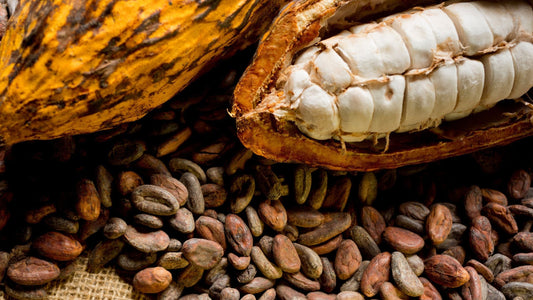
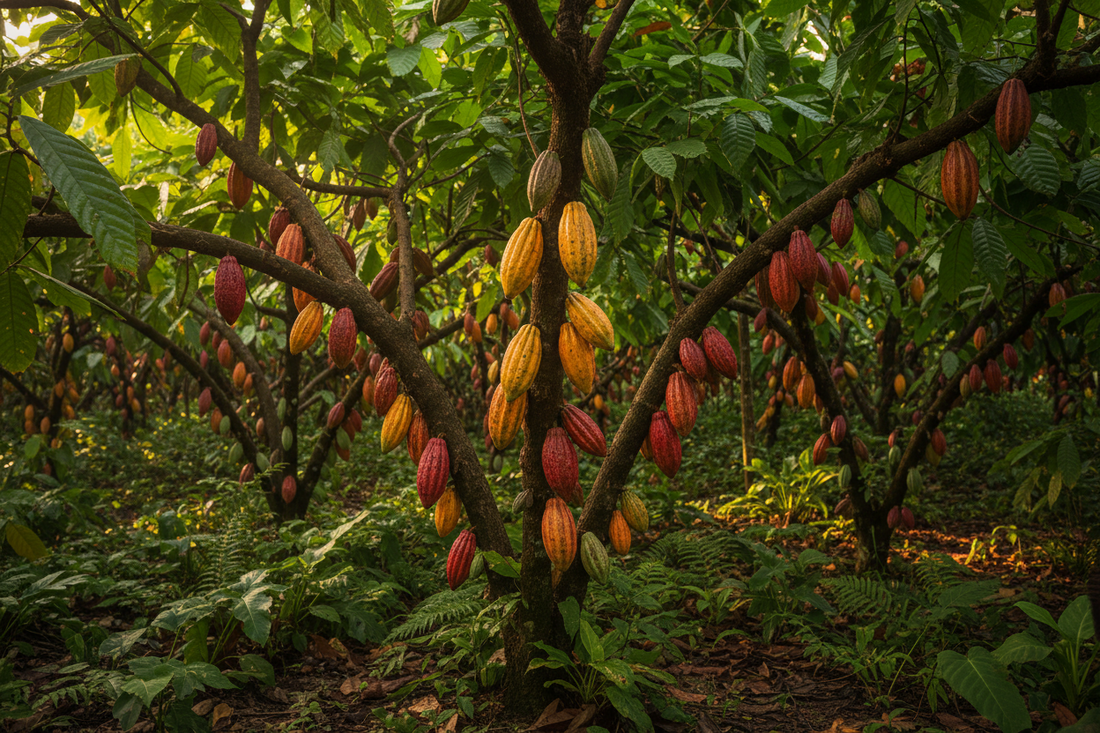
The cacao tree (Theobroma cacao - literally "food of the gods") is deeply climate-sensitive. It thrives in a narrow band around the equator, requiring specific temperatures, humidity, and rainfall patterns that have become increasingly unpredictable.
West Africa - which supplies roughly 70% of the world's cacao - has been hit hard. Erratic rainfall, prolonged dry spells, and shifting seasons are disrupting harvests in ways that no supply chain can fully buffer against.
This isn't a blip. It's a trend. And the farms most vulnerable are the small, family-run operations that have fed the global chocolate industry for generations.
2. The Farms Themselves Are Ageing
Many cacao-producing regions are facing an agricultural ageing crisis. Farmers in Ghana, Côte d'Ivoire, and across West Africa are aging out of farming - and their children aren't always following. Why? Because the economics have never made it worthwhile.
The average cacao farmer earns less than $2 per day. After decades of being paid poverty wages for a product that generates billions in global chocolate sales, the next generation is choosing cities, education, and other industries over inheriting a farm that barely sustains a family.
Aging trees compound the problem. Cacao trees peak in productivity between 10 and 15 years, and many farms across West Africa have trees that are 30, 40, even 50 years old. Replanting takes time and money that most smallholders don't have.
3. Disease Pressure Is Significant
Swollen Shoot Virus and Black Pod Disease have devastated large swaths of cacao-producing land in recent years - and are estimated to destroy up to 40% of the global crop annually. Without investment in disease-resistant varieties, soil health, and farmer support, this pressure will only intensify.
4. And Yet - There Are Farmers Sitting on Unsold Beans
Here's where the narrative gets complicated.
At the same time that supermarkets are crying "shortage," there are farmers in West Africa who can't sell their harvest. Beans sitting in warehouses. Farmers waiting.
Why? Because this isn't a simple supply problem. It's a systemic imbalance of pricing structures, quality thresholds set by corporate buyers, logistical failures, and the distorting power of commodity futures markets - where the price of cacao is set by traders in London and New York, not by the farmers who grew it.
Large commodity buyers can delay purchases, switch origins, or hold out for lower prices - leaving farmers exposed. Meanwhile, the futures market creates price volatility that has almost nothing to do with the actual volume of cacao in the ground.
This is not a shortage. It's a broken system.
Now Tech Companies Want to Engineer Cacao Out of the Equation
Into this complexity steps a wave of biotech startups racing to create "cacao-free chocolate" - synthesising the flavour compounds of cacao in a lab, growing chocolate cells in bioreactors, and pitching it as the sustainable solution to a supply chain problem.
We want to ask the question that these press releases aren't asking:
What happens when we disconnect cacao from the land it grows in, the farmers who tend it, and the lineage of meaning it carries?
Cacao has been cultivated for over 3,000 years. It was currency, ceremony, and medicine long before it was a commodity. Indigenous Mesoamerican cultures understood it as a plant ally - a heart opener, a nervous system regulator, a bridge between the physical and the spiritual. That knowledge is embodied in the seed, in the soil, in the people who have grown it for generations.
You cannot extract that in a lab.
Lab-grown cacao might produce something that tastes like chocolate. But it will never carry the energetic signature of a bean grown in the highlands of Peru under the hands of a Criollo farmer. It will never hold the same relationship to the earth. It will never be plant medicine.
And if we remove economic value from real cacao farms, we accelerate the very abandonment and deforestation we're trying to solve.
For Us, Cacao Has Never Been a Commodity
At Cacao Collective, we've always been clear about where we stand.
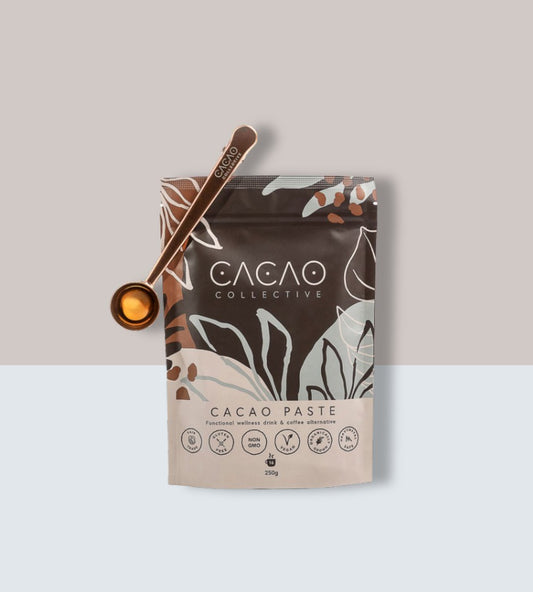
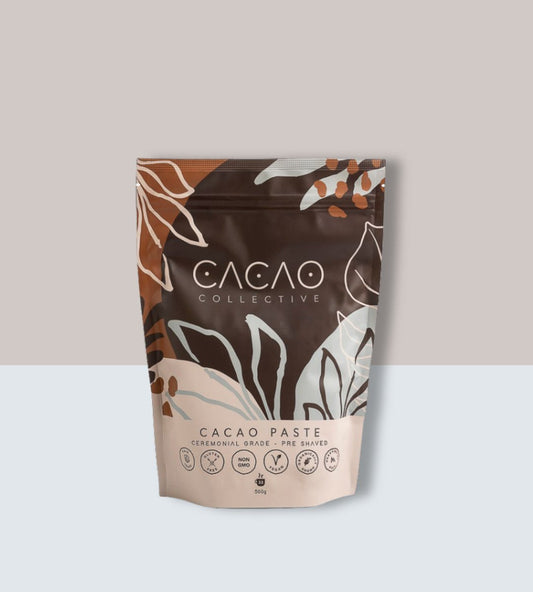
Our ceremonial cacao is sourced from ethical, sustainable farms - 100% organic Criollo cacao from Peru, single-origin, single-ingredient, with nothing added and nothing removed. We trace our supply chain because we believe that transparency is not a marketing strategy, it's a moral responsibility.
Cacao, to us, is a plant medicine. A cultural legacy. A deeply human experience rooted in connection, craftsmanship, and origin.
Every cup you make is connected to a tree, a farm, a farmer, and a tradition that spans millennia. That's not a story we made up. That's what it actually is - if you're sourcing it with integrity.
The Future of Cacao Is Splitting in Two
We believe the cacao world is heading toward a fork in the road.
On one side: mass-produced, commodity-grade, engineered chocolate. Optimised for cost, shelf life, and scalability. Disconnected from origin, culture, and ecological context. Familiar. Affordable. And fundamentally diminished.
On the other: transparent, regenerative, ceremonial cacao - sourced directly from small farms, fairly traded, grown with ecological care, and held in cultural context. Slower. More intentional. More expensive. And infinitely more meaningful.
These two paths serve different values. They represent different relationships with food, with the earth, and with ourselves.
We've chosen our path. And we believe more and more people are choosing it too.
What You Can Do
More than ever, where your cacao comes from matters.
When you choose single-origin, ethically sourced, ceremonial-grade cacao, you're not just buying a wellness drink. You're:
- Paying a living wage to farmers who have long been undervalued by the global market
- Supporting regenerative agriculture over extractive monocultures
- Preserving biodiversity in some of the world's most ecologically vital growing regions
- Keeping alive a plant tradition that has served human wellbeing for thousands of years
The cacao industry is at a turning point. The choices that brands and consumers make in the next few years will shape what "cacao" means for generations to come.
We know which version of the future we're building toward.
We hope you'll join us.